


Choose a leaf rake by the ground you actually clear, the gaps it must reach and how the complete tool feels in your hands. A broad fan head suits an open patch of lawn. Beside pots and established planting, a smaller head or adjustable spread may be easier to control.
Start with one ordinary leaf-clearing job at home. Note the narrowest working gap, where you will gather the leaves and where the rake will live afterwards. Those details are more useful in the shop than choosing the largest head on the rack.
Match the head to loose leaves
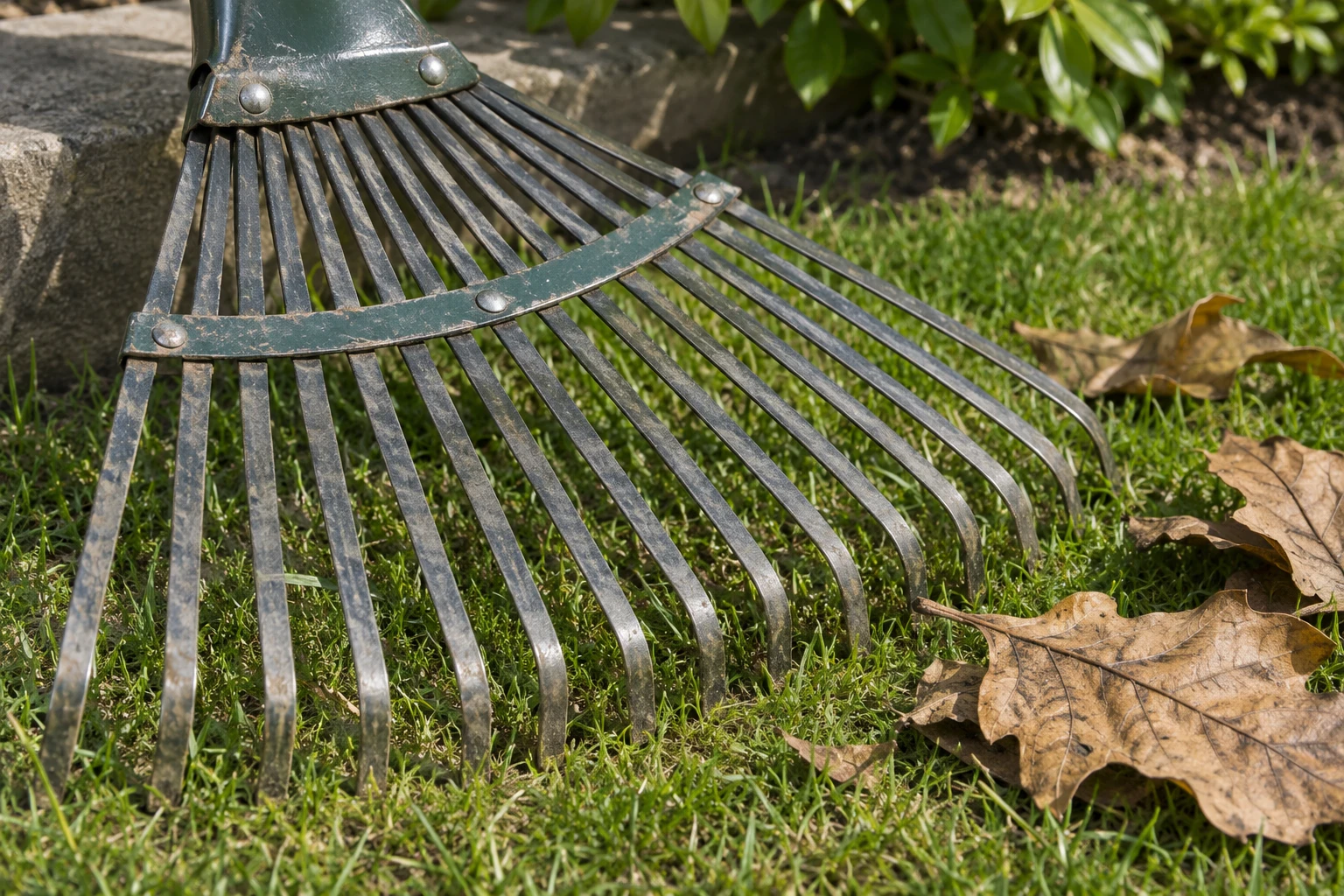
Look for a fan of flexible tines with turned ends. This is the familiar shape used to gather light material across a surface. Thrive's guide to raking tools distinguishes it from the straight row of short, rigid teeth on a soil rake. The latter has a different job, breaking and levelling soil.
Read the exact model's intended use. Some tools sold as lawn rakes also suit more vigorous work, while others are primarily for collecting leaves and light debris. Removing thatch is a separate decision with its own timing and turf checks, covered in our lawn scarifying guide.
Inspect the whole row of tips. On a used rake, look for missing or cracked tines and a badly distorted fan. If your present rake still collects well, a loose fixing or worn handle may be the only part that needs attention.
Compare width with the awkward parts
Measure the clear gap between the objects you work around. Include the room needed to pull the head back towards you. A wide head that fits across the lawn can still be awkward between two planted containers.
An adjustable fan gives you another option. GARDENA's adjustable-rake specification shows how spreading or closing the spring-steel tines changes both working width and tine spacing. Check those two changes together on the model you are considering. A narrow setting does not turn a long-handled rake into a hand tool for reaching deep into a planted bed.
Operate the adjustment in the shop if permitted. Can you release it, choose the spread and secure it again while wearing your usual gloves? A fixed head may be simpler if you only clear one open area. For a tiny gap beside a treasured plant, picking out a few leaves by hand can be easier than buying another large tool.
Try the complete rake
Compare assembled tools, including the handle. Bring your hands into a comfortable working position and make a short, gentle pulling movement in clear space, with the shop's permission. Notice whether you keep reaching forward or lifting the head awkwardly to reposition it.
Handle length, weight and grip all affect that trial. A catalogue photograph cannot tell you whether a smooth shaft feels secure through your gloves. Adjustable handles offer a choice of length, but check the locking mechanism as well as the range. If you usually garden from a seat, try the tool from that position.
Compare the tine materials without assuming that metal always means stiff or plastic always means flimsy. GARDENA's example uses flexible spring steel. Check the maker's description of the tines and judge the actual assembled model alongside its intended use.
Check the joint and its next home
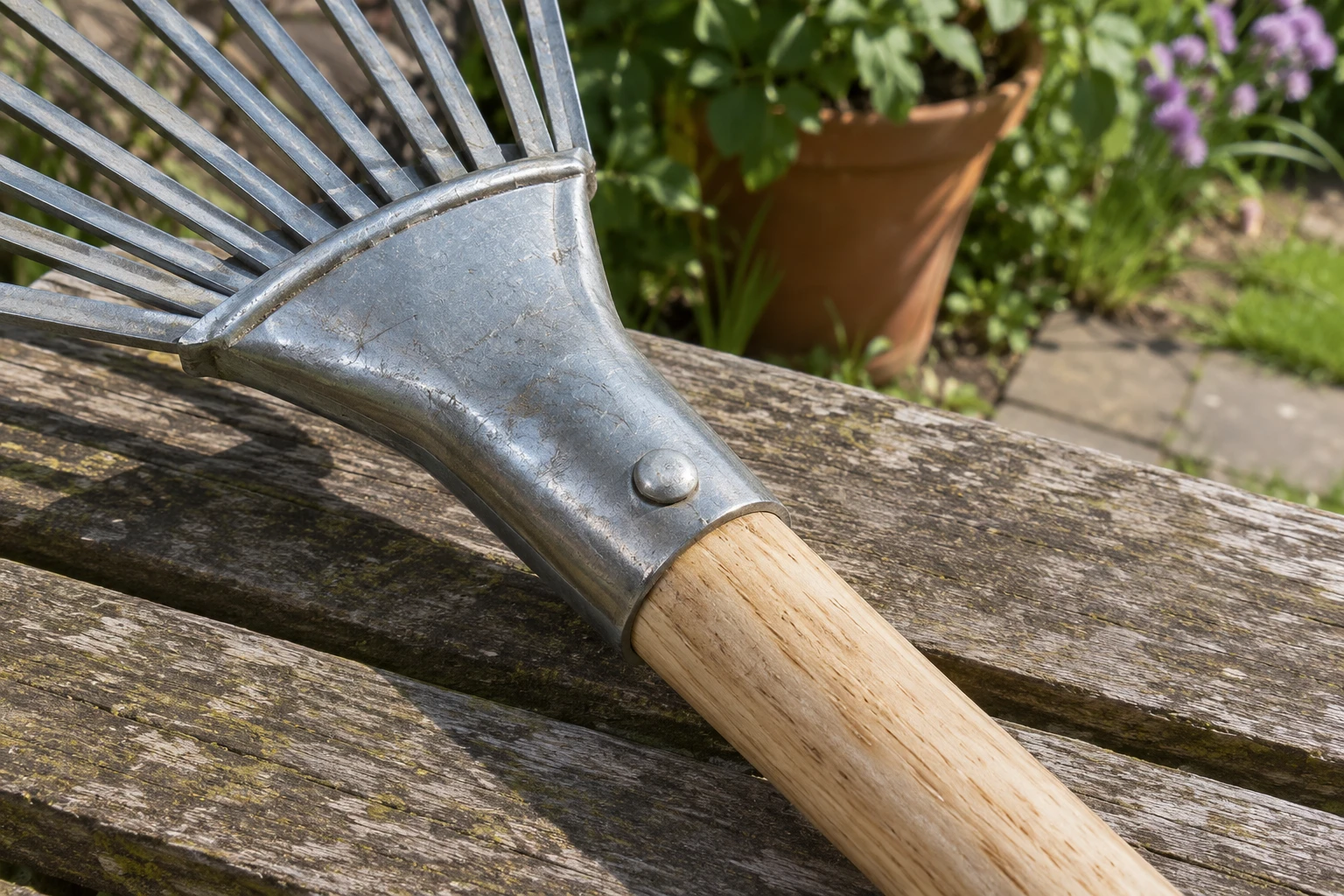
Look closely where the head meets the shaft. Ask how the connection is secured and which parts can be replaced. An interchangeable head needs the matching handle system; a similar-looking socket is not proof of compatibility. Check the exact model number before ordering parts.
Read the maker's cleaning and storage instructions. Confirm that the full head fits through the shed doorway and into its allocated space. Adjustable spread is useful only if you can still reach its lock after bringing the tool inside. Our garden storage guide covers arranging the equipment you already own around ordinary jobs.
Plan where the collected leaves will go, too. The leaf mold guide explains a separate leaf-only batch once you have gathered them. If you later rethink the surrounding planting, Gardenly can help explore its broad appearance. Keep tool fit and working clearances in your measured notes; a generated garden image cannot check them.
