

Choose a garden pruning saw by the wood you need to manage and the space available for a full sawing movement. Compare the exact blade's intended material, its usable length and the handle in your own hand. A compact folded package tells you little about how the open tool will fit between branches.
Start with accessible small jobs you can approach comfortably from the ground. This is a buying guide for ordinary manual saws. Large limbs, awkward overhead work and branches near power lines need a separate assessment by a qualified arborist.
Decide whether the job needs a saw
Record the plant, the approximate branch thickness and whether the wood is fresh or dry. Check why it needs cutting and when that species should be pruned. The RHS tree-pruning guide starts with plant identification and suitable timing. A new tool does not settle either question.
If your existing pruners handle the stem comfortably within their stated limit, you may already own what you need. Our hand-pruner guide covers that choice. Loppers add leverage but require room for two handles to open.
A saw replaces that handle-spreading movement with a travelling blade. Photograph the gap around the branch from your actual standing position. Include nearby stems and anything that could interrupt the stroke. Keep this photograph with your measurements when comparing tools.
Leave room for the whole blade
Compare the open saw, not just the blade length printed on its packaging. Check the space beyond the branch as well as the room for your hand. A long blade that continually meets another stem will be awkward even when the target branch is within its stated capacity.
Iowa State's equipment guide explains why pruning saws use narrow, tapered or curved blades to reach crowded growth. Shape still needs to suit your particular gap. Ask to see straight and curved examples side by side, with their teeth covered or otherwise handled as the retailer directs.
Read the exact model's recommended branch sizes. Avoid choosing the longest saw simply because it looks more capable. You need a manageable tool with enough working clearance for your usual jobs, and a separate plan for work outside that range.
Match the teeth to your wood
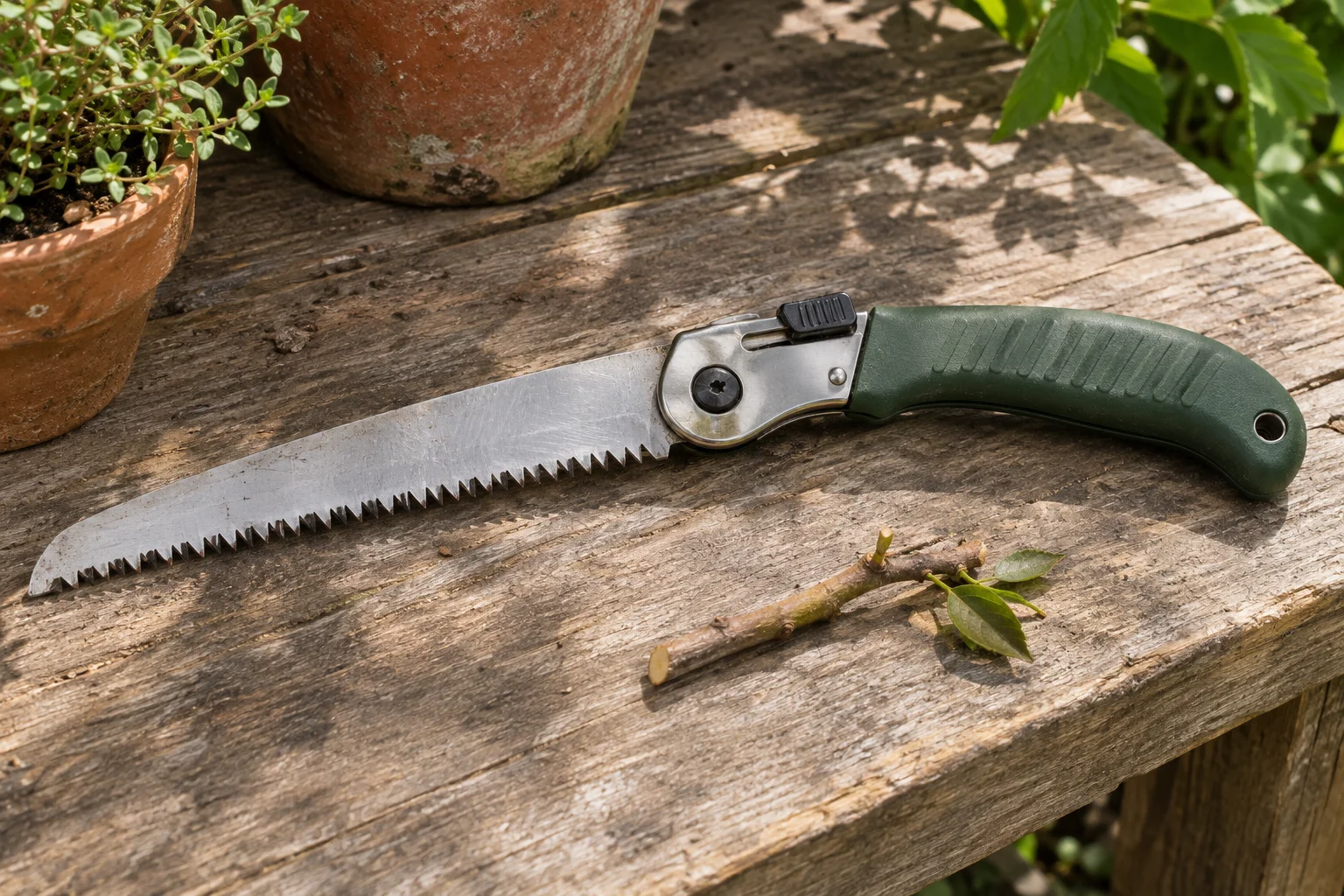
Check the blade's description for fresh wood, dry wood or both. Tooth spacing varies, and the counting units on two labels may differ. Teeth per inch and teeth per thirty millimetres are not identical measurements, so compare the stated use before comparing numbers.
Silky's technical guide distinguishes tooth patterns for different wood conditions. Use the maker's guidance for the specific blade you are considering. A coarse-looking blade is not automatically the best choice for every shrub.
Also check the cutting direction. Many pruning saws cut on the pull stroke, while some designs cut in both directions. Have the retailer explain the intended action before buying. Do not test an exposed blade by running a finger over its teeth.
Try the grip and understand the lock
With permission, hold the handle while wearing the gloves you normally use. Keep the blade protected for this fit check. Your fingers should sit comfortably without crowding the hinge or slipping towards the teeth. Compare how the complete tool balances in a relaxed working position.
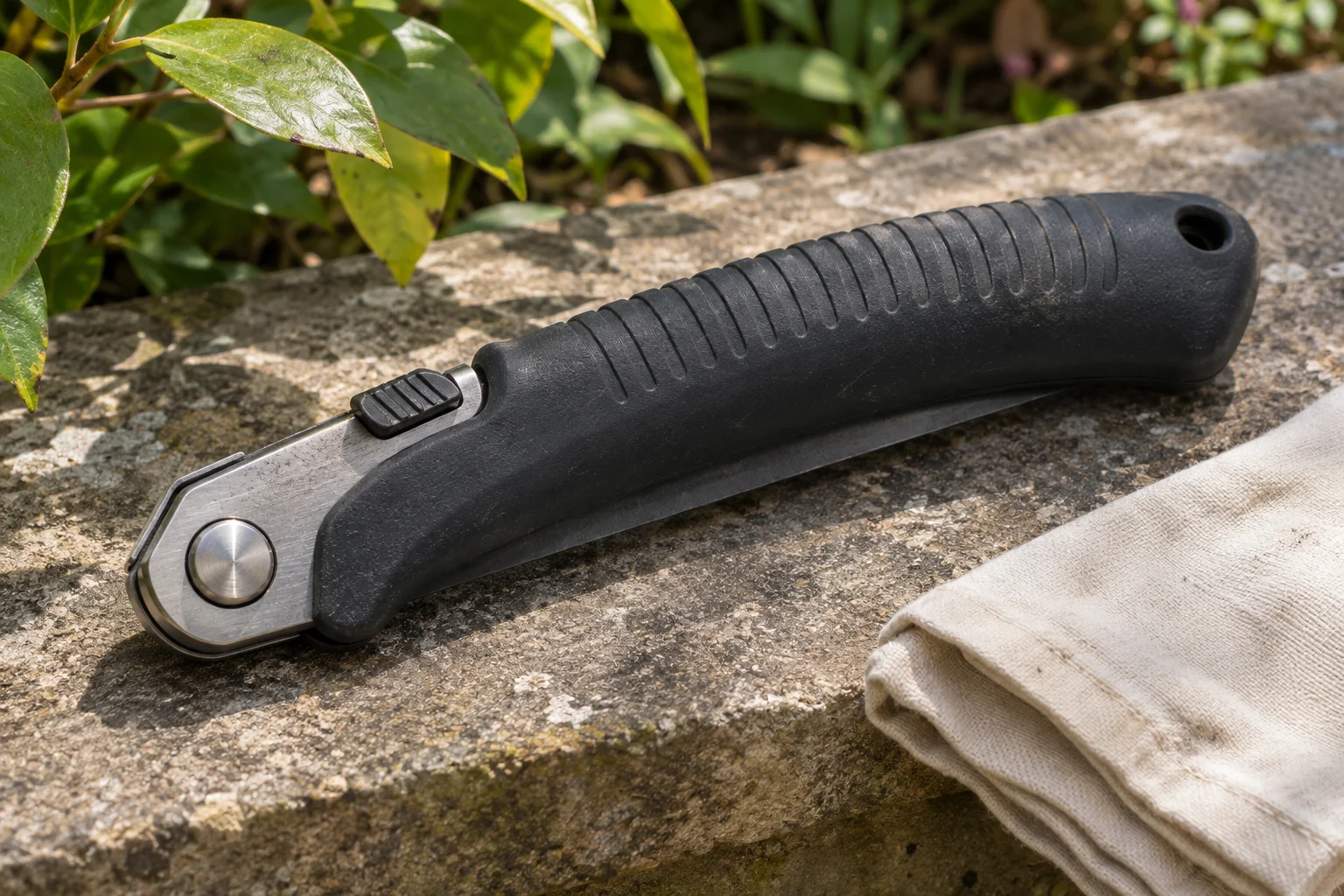
For a folding model, ask for a demonstration of opening, locking and closing. Check how to confirm the blade is secured and where your fingers must stay during folding. A lock that is difficult for you to operate deserves attention before the tool goes into your basket.
Check the blade's future before paying
Find the exact replacement-blade number and ask whether your supplier stocks it. FELCO's model 600 parts list lists a blade and locking closure separately. Other saws have different arrangements, so check the actual model rather than assuming every part can be replaced.
Read its cleaning, drying and sharpening instructions too. Some hardened teeth require blade replacement instead of ordinary filing. Plan a storage place where the teeth stay covered and the tool is out of children's reach. A fixed-blade saw needs its appropriate sheath.
For a wider border rethink, Gardenly's styles can help explore the surrounding planting's appearance. Keep the real branch measurements and tool notes for the equipment choice.
